Smelling the Petrichor


That afternoon, I watched the clouds start to move in, like soldiers in a parade.  First the thin wisps, string like, faint white against the summer blue sky that was the hallmark of our warm and dry summer.

The grass crunched under my shoes as I made my way out to my favorite chair in the front yard, the place of lemonade sipping, book reading, and enjoying the bees, birds and summer afternoons.  Even where we had watered, the leaves of shrubs and flowers looked thirsty, wilting and brittle.

I tried reading my book, but I was soon lost in watching the weather change, thin white streaks, then horsetail clouds, looking more like breaking surf at the beach.  Popcorn clouds came next, all in a checkerboard, neatly separated by the blue border of sky.

Something deep inside of me, something primeval, told me to focus, and pay attention to this change, this moment in time.

White gave way to shades of gray, as the checkerboard thickened, and turned into ropey strands, making a basket weave pattern across the western sky.  The bright summer sun dimmed, turning to silver, and then a platinum blue, behind the new curtain of clouds.

The wind stilled, then freshened, and changed direction, as the afternoon parade marched by.  Faint odors of cut hay, newly harrowed dirt, and summer dried forest spiced up the air.  Even a bit of salt from the ocean ten miles away caught my nose, reminding me the weather was changing, and rain was on its way.

The wind shifted again, and more open blue sky appeared above me, and then more of the checkerboard and then the ripples of an ever thickening cloud cover.

My chair was a good place to practice my guitar, serenading the hummingbirds and late summer robins and sparrows, and sometimes the neighbor’s dog, who comes by often to visit, and bark when I play Johnny Cash. Today, though, the guitar strings were fussy, needing to be retuned again and again, as the air pressure changed, making all my notes go flat. My wooden barometer was falling, and I had to readjust.

After dinner, I returned to my chair, to enjoy my book again in the falling light of the evening, and to savor perhaps what was the last dry evening of summer. I wanted the rain, yet I didn’t want to let the summer slip out of my hands.

When it was finally too dark to read, I abandoned my post as the weather watcher of the yard, disappointed that I hadn’t felt that first drop of rain on my arm and my face, alive, almost electric.  The clouds had thickened, gray turning to black.

Just before bed, I checked again.  Still no rain.  The yard was silent in anticipation.

I awoke at two, stirred by a sound, something new. I felt called, a muted voice telling me to check it out.  Something had changed. It was time to pay attention.

As I opened the door, my nose came alive with the smell I’d been yearning for.  Alive, yet with some musk, something smelling dry but damp, both stale and fresh.

Petrichor.  The name of that smell.

“…the term was coined in 1964 by two Australian scientists studying the smells of wet weather — is derived from a pair of chemical reactions.

“Some plants secrete oils during dry periods, and when it rains, these oils are released into the air. The second reaction that creates petrichor occurs when chemicals produced by soil-dwelling bacteria… are released. These aromatic compounds combine to create the pleasant petrichor scent when rain hits the ground.” (livescience.com, 2013)


The word petrichor is created from joining the Greek words for stone and the blood of the gods. It is a word that is conflicted, just like what it tries to describe.  Inert, yet alive. Solid, yet flowing.


Deep in the lower reaches of my brain, the place where my ancestors’ voices can be heard, where I think ancient memories reside, there arose a sense of familiarity and comfort. Petrichor.  My ancestors knew it well.

And it was raining and I was satisfied, relieved. The deck and the leaves of the roses were wet and shiny, even in the dim light of the night. Fresh and new, coming alive.

The arrival of the rains mark the new year for me. September is a time of great change. The cool, wet weather, the start of school, the approach of the fall Equinox, harvest time, historically the beginnings of war.

Now is the Jewish new year, Rosh Hashana.  It literally means the head of the year. This is the beginning of the agricultural year in the Mideast.  The tradition has been traced to the earliest times in Egypt.

The garden is alive again, leaves are full of moisture, the grapes are fattening and ripening in new found wetness. I’m coming alive, too. My creative juices are flowing, and I’m creating new art. The late summer doldrums are giving way to new energies and ideas.

It is time to grasp the possibilities of the new year. Have a good and sweet year!


–Neal Lemery, 9/13/2018
Celebrating Fathers’ Day


Tomorrow is Fathers’ Day, and I know we are all expected to celebrate it. Fathers are special and should be honored on their special day.  It is supposed to be a day of wholesomeness, warm feelings, sentimentality, and unbounded familial love. That’s what all the Fathers’ Day cards say, anyway.

But, there’s a lot of mixed emotions, and turmoil under the surface of having the barbeque, giving a card, and a nice present.  Or, to be on the receiving end, and be thanked as a father in someone’s life.

There are so many strings attached, so many thoughts and memories that come to the surface, so many conflicting and unsettling experiences to sort through and try to make sense of. All the sentimentality and idealism can be a trap for the emotionally wounded, those of us who have other emotions and memories about fathers, the ones you can’t find in a Hallmark card.

And if Dad has passed away, or is otherwise absent in one’s life, there’s grief and the psychological jungle of things left unsaid, words that we regret, or words that we are desperate to hear or speak.  Those children have no place and no role to play in a day of a sentimental card, a barbeque, or a gift of golf balls.

We don’t talk about that emptiness, that pain, but we should.

What is a good father?  Even our cultural heroes and role models aren’t really what we had imagined, or thought of as solid, stable figures in our lives.  When my wife and I were raising my stepson, we watched Bill Cosby’s show, and I thought he was the good dad — sensitive, kind, compassionate, the kind of dad I wanted my son to emulate in his life.  Yet, that image of wholesomeness and stability has been dashed on the rocks of reality, and a conviction for predatory abuse and exploitation.

In my own life, I have seen stories and accepted history and experiences being altered by unsettling revelations, confessions, and recovered memories.  The charming and comfortable portrayals of healthy and good parents have shifted, from the fall of Dr. Huxtable as the all wise and kind father figure to the realization that real life isn’t always the story of Leave It To Beaver or Father Knows Best.


One thing that is absent in our society’s Fathers’ Day celebrations is a conversation about what is good fathering, and how we can strive to be better fathers, and better sons and daughters.  We need to look at new gifts to give on dad’s special day, other than a new tie, tools for the barbeque, or golf balls.

Good parenting is a skill, and we need a day to ponder that, and have a real conversation about being the great dad, and how we can build healthier families.

In reality, living in the world of truth really is better for me than fiction, the fantasized and idealized “perfect world” created by Hollywood and our society’s desire to sugarcoat our historical reality.

Though, part of me longs for the dream world of the idealized childhood, and the warm and fuzzy images of the ideal Fathers’ Day experience. Part of me wants the nice sweetness of Dr. Huxtable, Ward Cleaver, and Sheriff Andy Griffith to be part of my Fathers’ Day party.  But, those icons of healthy fathering aren’t in my reality, and I’ve hopefully learned how to separate the television fantasies from truth.

If fatherhood had a god, it would probably be Janus, looking both forward and back, showing us how those two perspectives can often be contradictory.  Life is messy.

My experiences as a father always involves looking back as my experience as the son, and realizing that much of my fathering work is shaped by how I saw my father parented me. I’ve had other men who parented me, too, sometimes in momentary blips of insight, compassion, and correction.  And, I’ve become increasingly grateful for those fathers who took it upon themselves to get my attention and offer some kindly, and often needed, direction and counsel.

Like Janus, I’ve looked back on that work and hopefully used that wisdom in my own work as a father.

I’ve mentored a number of young men who have needed some fathering and attention to the tough business of growing up in this world.  I’ve drawn upon my own experiences as a son, and as a father, and helped guide them through their own storms and battles.

The reward in that is to hopefully give them a better experience that I’ve had as a son, giving direction and guidance, without a lot of the harsh judgment and anger that can easily derail a young man in his journey.

I’m not the perfect father.  And, I certainly wasn’t the perfect son.  I’m content with that, but I also know that this work of fathering is really never completed, that there are always going to be opportunities to be fatherly, and to give to others what I have needed in my past.

If we are mindful of that work, and those challenges, perhaps that is what we should be thinking about on Fathers’ Day.

6/20/2018

Getting Distracted


Some of the best conversations I’ve had occur in the aisles of the local grocery store. There, in those spontaneous and seemingly random encounters, I find the greatest wisdom, coming from longtime friends who speak profound wisdom and solid Truth.

We nearly ran into each other, grocery lists in hand, and quickly caught up on the successes of a mutual friend.  Our similar political views led us to some hand wringing about one of the current scandals on what I’ve been calling our collective national news feed.

“But, it’s really all a distraction,” my friend says.  “Keeping us from talking about and taking action on the really important stuff.”

My friend is right. I am distracted, feeling like I’m jumping from one outrageous story to another, never having the time to be fully morally outraged about an event or a trend, when another absurd or unsettling story blips on my radar screen, stirring up my indignation, and leading me down another rabbit hole in the political and cultural scene.

Some of my angst comes from not feeling I’m taking action myself, righting some injustice through my own actions, or simply not speaking out at all, because I’m distracted.

I’ve been finding some direction and camaraderie with a wise person from the nineteenth century, Ralph Waldo Emerson.  Politics and culture in his time weren’t tranquil and serene, and, in his writing, he spoke out against injustice, hypocrisy, and what one of my social worker friends calls “stinking thinking”.


“At times the whole world seems to be in conspiracy to importune you with emphatic trifles. Friend, client, child, sickness, fear, want, charity, all knock at once at thy closet door and say,—’Come out unto us.’ But keep thy state; come not into their confusion. The power men possess to annoy me I give them by a weak curiosity. No man can come near me but through my act.”  —Ralph Waldo Emerson.


I’ve been distracted from being purposeful, intentional, and acting against the intolerance and injustice of our times.


“The purpose of life is not to be happy.  It is to be useful, to be honorable, to be compassionate, to have it make some difference that you have lived, and lived well.”


_Ralph Waldo Emerson


Am I living well, am I living to be useful and compassionate, and making a difference? Like all of us, I suspect, I want to be living in the here and now, to be productive.

My grocery store conversation stirred me up, and I’m motivated to keep at it, keep doing my life work, and making a difference.


I’ve long believed that social ills and “stinking thinking” are best addressed by a good public airing, so people can truly see a thought or an attitude for what it really is.  One of my missions in life has been to seek the truth, and bring it to light.

My friends in the medical community often talk about the curative properties of sunlight and fresh air, and how infections often respond to a change in the environment, and the need for a thorough examination under a bright light, bringing in fresh air, and creating a place where healing can begin.

I’ve long enjoyed the idea of clearly identifying the elephant in the living room, so people can begin to talk about the real problem, take ownership and responsibility, and move towards finding solutions. Such clarity and directness gets us “down to brass tacks”, as my grandmother used to say.

Then, another news story, and a flurry of unreasoned opinions, rants, and personal attacks. Distractions, again.

Uncivil discourse, a sign of the times.

Blindsiding and personal attacks; not having meaningful, purposeful conversation about the issue at hand  — it all reminded me of what our national political conversations have turned into, a lot of noise taking away our need to focus on productive discussions and the elephant in the living room. We are being distracted from expressing and sharing, not having well thought out and articulated debates on issues vital to our national health and direction, and respecting people’s views, even if we might disagree with them.

My grocery store encounter with my good friend reminded me that distractions are simply that. They get in the way, and keep me from my purpose in life and in my community.  I need to keep focused on the task at hand, the issues we are facing, and carry on, “to be useful, to be honorable, to be compassionate, to have it make some difference that you have lived, and lived well.”


–Neal Lemery, 6/1/2018


Letter to a Graduate


May 22, 2018


It is almost that time, so Congratulations on Graduation!!!!


Earning a bachelor’s degree is a very big deal and a huge accomplishment.  There is a great deal of work involved, and persistence and determination.


I believe that you have truly applied yourself and gained much from this experience.  I hope that you have learned how to learn, and how to think analytically, and that you have been exposed to a great amount of ideas, viewpoints, and opinions, and have had to develop your own thinking and analysis to issues and situations.


I also hope that you are an avid “lifelong learner” and this is only a step in your continuing education and development.


In my experience, college and being devoted to learning and education and development of the mind is one of the most worthwhile activities in one’s life.


Which leads me to the topic of “patience”, and change making.  I have had a lifetime of struggle with being patient.  My mentors continually counseled me about being patient.  My grandmother and mother taught me a lot about gardening, with the ever present message of being patient.  Time can be on my side and can be an asset, very useful tool.


And, over time, one can observe and see patterns and trends that otherwise would not be observable or discernable.


I see the benefit of patience in my art and music, too.  Time is actually a very good teacher, and it takes the passage of time for the body and brain to fully learn and develop.  And, probably why I am attracted to Zen Buddhism, as a spiritual practice and source of wisdom, letting time move and being in the moment.


Yet, the tension for me is that I know I am often ready to move on, that I have learned my life lessons in a place and the experience, and enough is enough.  Let’s get it on! I’m really a “get it done, now, already” kind of guy.  I don’t suffer fools well, and when the lessons are learned, why wait around?


Yet, when I have to wait, I observe more, and I think more, and I probably learn the lessons of the experience better, and then able to teach those lessons better to others. And, to remember and “do” something with the experience in a better way.  My “product” is better because it has more time to ripen, to come into its true form.  And, I guess, to confirm my hypotheses and conclusions.  A period of testing, refining, perfecting.


Intellectually, I have come to peace about that waiting process.  I’m not sure if I have come to peace about that spiritually, though.  I’ve concluded that karma is real and comes about over time, sometimes a really long time.  But, if I can wait it out, then karma is sweet and is to be savored.  I try not to be a revengeful person, but there is a proverb that says that revenge is a dish best served cold.


Perhaps the better, more Zenlike approach, is to be the actor for positive action and change, going around the roadblock and the evil, and building a better road for others.  And, if good actions are stymied, then being satisfied with being the example, the exception that proves the rule, and thereby the force for change and new thinking.


There’s another saying about good people doing what others are saying can’t be done. I’ll look that up, because that is probably a good motto for my life.  Over time, I’ve noticed that what I thought has been revolutionary is seen by others new to the scene as an existing, functioning phenomenon that is accepted as “always being there”.  Truly a successful revolution.


Often, what I’ve found, is that real change occurs in seemingly random, spontaneous conversations. The grocery store, at a gathering, maybe lunch with a friend.  Those little conversations are really the gems, the gold to be mined, to engage and enliven people and give them permission to have the good, the deep conversations and searches.  Other tools, other works, such as writing and music and art, are more the examples, the stimulators of those conversations and experiences.  They provide the metaphors, so one can talk about scary things in a safe way.


Can I suggest that this time is gold for you?  You have climbed the mountaintop, and you see things now for what they really are.  And, in not too long of a time, you will leave the undergraduate world and not have the current struggle, the current experience. That impending end can be liberating in its own way.  You see the truth and know it.  Others may find the truth to be too scary, too real, and thus avoid it.


Thus, a teaching moment for you, space and time to plant some seeds of thought and ideas, and of encouragement to others in their work.


The revolution for you has already begun, and you are planting those seeds of change right now, where you are at.  Not flashy or noisy.   Education takes many forms. Others find that scary, something that needs to be limited, constrained, and yes, imprisoned.


It will be exciting to see how your journey unfolds.  I hope you are open to what will come your way, and that you will take risks, and opportunities, and plunge into the unknown and uncertain.  And, anything you attempt in good faith will not be a dead end or a “wasted” opportunity.  Gold is where you find it.


Respectfully,


Neal C. Lemery


Making The Rounds


I was making the rounds on a quiet Sunday morning.  A heavy mist was falling, almost floating down.  A Scotsman would call it a smirr, heavier than a fret.  My raincoat soon failed at its task and my shirt turned as cold and clammy as the grass I was stepping through.


A cold front was moving in from Alaska, promising to bring snow to the hills tonight, and yesterday’s warm, still day with filtered sunshine was just a memory. The calendar says that it is spring, yet, the mornings come with either bits of hail on the sidewalk, or frost on the lawn.  The daffodils, brave as they were, are fading away in this cold weather. Every other spring flower is still hunkered down in the ground, waiting.


I check out the greenhouse, where I am the eternal optimist.  Cuttings of geraniums and other summer delights are doing well, even sending out new growth, and an occasional flower.  I’ve potted them up, urging them to grow strong, as May is coming, and I promise to put them outside where they can flourish.  Yet, my words ring hollow, as the stiff wind from the north and the scattering of hail on the greenhouse roof contradicts my sermon on the coming of spring.


I plant some seeds in my seed flats, hoping it is warm and bright enough for them to start making their way in this world. I promise them sunny days and warm dirt, if they can just get started and join me in waiting for the coming good days.  I marvel at the variety of all the different seeds, and how they can quickly spring to life and change the world.


I’m drawn to magic and witchcraft, though, or at least alchemy.  Turning lead into gold, or planting seeds, it seems like the same kind of idea.  Planting seeds is a sign of eternal optimism and miracle making, I think.  Seeds look pathetic, dry, hard, looking nothing like something that contains life.  Yet, put them in some dirt and add some water, and sunlight, and they turn into green plants growing leaps and bounds, is nothing short of miraculous, or alchemy.  Gardeners might want to think they are biologists, or at least practitioners of good husbandry, yet I really think we are alchemists and magicians at heart.


Outside, I take census of the land and what is going on.  A small flock of geese flies overhead, the leader calling to the others, as they make their morning rounds to the river and then back.  Soon, they will be nesting and raising the next generation of what has become a small flock of geese who have taken up permanent residence here.  Perhaps they have tired of the annual commute to California and Alaska, preferring to endure our wet winter and mild summer in return for not having to deal with all that travel.


The calls of the small flock are a welcome sound in my day.  The flock has grown over the years, from a pair, to four, and now to about a dozen.  I’ve always called a group of geese either a flock, or a gaggle.  Yet, the other day, reading an English author, I learned that true Brits call a group of geese an argument.  The steady, persistent “honk, honk”, is, perhaps, best described as an argument.  It certainly sounds more poetic than the boring “flock” or even the melodic “gaggle”.


The neighborhood crows jump in, their raspy, throaty “caws”, grate against my nerves, as they give their own commentary on the day’s activities.  A group of crows is a “murder” and that seems to match their persistent and annoying conversations.

.

The morning task is to stake and fertilize the young trees I’ve planted. My neighbor, the forester, gave me several dozen year old seedlings a few weeks ago, and I found room for them on the far end of our property.  They will be good windbreaks, and also a good buffer against the other neighbor, the one whose kid can ride his dirt bike around and around, revving the motor and overcoming the call of the neighborhood band of geese making their rounds.  Even the red-tailed hawks soar away to more peaceful hunting grounds when the kid decides to get out his dirt bike and go for a spin.


I’ve always enjoyed planting young trees, helping my dad out as we replanted a hill above our cabin, part of the Tillamook Burn. A few years later, the trees were growing well, and I could see that we had recreated a forest.  It seemed magical, and ever since, I’ve taken delight in helping Mother Nature growing a forest.


The recent cold rains have helped settle the young trees into the ground, and the fertilizer I’m adding is giving them a healthy start in their first year in their new home.  The neighborhood deer and elk aren’t much interested in my little corner of the neighborhood, so I’ve dispensed with putting up the wire and plastic cages to protect young trees from their appetites for young and tasty evergreens.


I add a bamboo stake next to each seedling, so I don’t lose track of it as the grass and blackberries grow this spring and summer, and they don’t get shaded out or suffocated by everything else that wants to grow here.


I’ve planted cedars, Western Red to be precise.  Native Americans called it a medicine tree, using bark for making cloth, the trunks for canoes and elaborate enormous lodges, even totem poles.  The leaves were used as tonics and poultices to heal.   Now, we know that the essences of the cedar roots are good for salmon in the rivers, and help to restore the ancient qualities of the water, helping salmon to find their way home and purify the rivers.


It is doing my small part to heal and restore the watershed where I live and make this small part of the planet just a little bit healthier.


Now, chilled to the bone, my sweatshirt cold and damp in the morning mist turning to rain, I finish my tasks and pull off my now cold gloves, and slip off my boots.  I close the garage door to the morning chill, and head inside, eager for my cup of tea and a good book.


—Neal Lemery, 4/21/2018


On Healing


This week, I’m focused on healing.  Hernia surgery does that to you.

Tests, doctors, being driven to and from the surgery clinic and getting an IV, all the procedures that are so routine to the wonderful healers attending to you, but new and different to me.  The daily routine has changed, and I am now focused on self care, and have time to heal.

In the past week, my life has focused on pill taking regimens, taking care with painful areas of the body, and the seemingly everpresent need to close my eyes and zone out.  Basic bodily care procedures take on a new importance and challenges, as I sense all the healing that my body is engaged in.

Time and patience, yet also pushing myself a little, me testing and experimenting.  And, listening to my body.

While occupying myself on the couch with books, laptop, and just watching the birds outside setting up their spring housekeeping and discovering the new blossoms on the wild currants, I came across an essay in the April 16 New Yorker, by Junot Diaz. He’s a noteworthy writer, who writes about serious issues.  Yet, “The Silence” reveals a story he has not shared before.

He takes me on his journey, into his wounds, exposing his pain and anguish, and the challenges he has faced in his own personal healing journey.  Uncomfortable, disquieting, yet so brave of him to take on pain from his childhood, and sharing his journey, and his healing experiences.

His courage and his honesty refreshes me, and helps me in my own journey of exploration and discovery.  I invite you to read what he has to share with us. https://www.newyorker.com/magazine/2018/04/16/the-silence-the-legacy-of-childhood-trauma


Healing starts from experiencing many wounds; healing comes from many sources.

Old wounds, scars nearly faded, remind me of good times, good friends, how I have changed and grown, evolving into who I am.

There are other wounds and stories, too.  Nightmares, tragedies, events I have buried deep and kept away from my conscious self, yet they are present in the own dark ways. As acts of self-preservation, I have buried them deep, yet they continue to shape and form who I am today, an integral part of my self.

Sometimes, I go there, deep and occasionally brave, digging and probing, rediscovering, exploring dark corners and hearing again stories that need to be told. And, sometimes, I am ready to hear their meaning.

I am not alone on such a journey.  Others do this work too, this self-discovery, this journey inward, downward, this course of study on themselves.

Others have led the way, and still others are following me, opening old pain to the light, part of our learning and growing.

The pursuit of who I am is a life long journey.  I need to be brave. It is when I fear what I might discovery, and don’t pursue these self-discoveries, then I am not practicing self care and self love, but only when the time is right, and this exploration is truly for the good of me.

I must be brave and ask the hard questions I am called to answer.  I must open the rusty lock and oil the squeaky hinges, and bring the light to see into the darkness.

Then and only then can I see the open wounds and the thorns that must be removed before the pain can begin to end and the healing begin. When the time is right, I must act and take charge of this part of the journey, and the healing.

I find strength in the courage of others in their journeys.  There are many teachers and guides in this journey.  From them, I have much to learn about courage and focus, that I am not alone, and that just taking a step can offer great rewards.

When the darkness becomes the light, and the shadows reveal their secrets, the weight falls off my shoulders and I can move ahead, becoming freer, less burdened, and lighter in spirit.

Mr. Diaz is one of my new heroes, one of those people who carries the lantern of truth into the darkness, and brings light to difficult conversations.


—-Neal Lemery, April 13, 2017

Today, 65


Me at sixty five today,
This birth day anniversary, as full of possibilities
As any other day of my life. It is just a
Number —challenging me to live each
Moment to the fullest in every day that
Remains for me to claim.

I stand on the beach where ancestors stood,
They living their lives in their own ways, their own
Times, loving others, solving problems, building for the
Future they would not see, helping to build the
World in which I live
And all the tomorrows. Their lives
Teaching me to do the same, teaching
Sacred duty.

Time can be a line or a circle, maybe a
Spiral, or a dance—-
Teaching me patience, perseverance, and
Possibilities coming from determination, purpose, the
Why of being alive and here.

I know now, after sixty five years, I can overcome ignorance,
Indifference with education and taking steps
Forward in every day that remains to me,
Gifts to be used to move forward, to
Change lives, spark love and compassion, realizing
Possibilities.

Sixty five, and moving on.

—-Neal Lemery, February 28, 2018

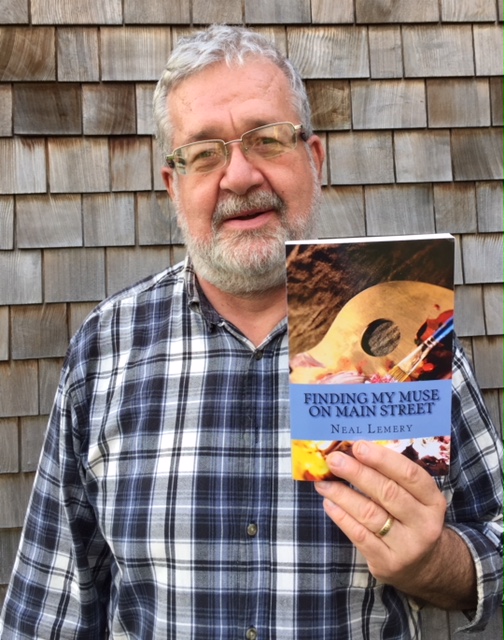
My New Novel, Finding My Muse on Main Street, is Published


Neal Lemery’s new coming of age novel, Finding My Muse on Main Street, has been published and is available on Amazon. The book explores the young creative spirit and the role of art in building community.

Growing up on the Pacific Northwest coast, small town boy Jake Morgan wants to find himself and his purpose in life. With the help of his many friends along Main Street, he lights his artistic creativity on fire. Taking the lead, he forges a coalition of artists, movers and shakers to build a community and open an art gallery on Main Street. Along the way, lives are transformed, including his own, on his way to manhood.


In this young adult novel, Jake discovers his own artistic gifts and dreams, and connects with others along Main Street, who are seeking their own artistic dreams and creativity. Together, they build a renewed community, healing old wounds and reinvigorating their lives.


A recent review praised Finding My Muse on Main Street:


“In this positive, uplifting, coming of age novel, a creative young man struggles to find his artistic self, with the help of the inhabitants of a small, coastal town. As he walks the path before him, he learns that almost all the people he knows have private, artistic lives which give them strength to endure the vagaries of life. The more he learns about and from them, the more each artist encourages him in his journey, the more he grows to know the path to himself involves making a place for the artists he knows where they can share with each other the art they create.


“The author shows how art can both forge connections and heal a broken soul, making it whole again, turning naysayers into enthusiasts of the creative spirit. I found myself cheering for the young man who cared enough for others to make his town a lovely place at the same time he was creating his own life.”


Lemery will hold a reading from his book during the downtown Tillamook, Oregon monthly Art Walk, on Saturday, February 24, 2018, at the Art Accelerated gallery, 1906 Third Street, Tillamook, from 1 to 3 p.m.


Lemery, a retired judge and now a community volunteer, is the author of Mentoring Boys to Men: Climbing Their Own Mountains and Homegrown Tomatoes: Essays and Musings From My Garden.


            More information is available at http://neallemery.com

Seeking An Intelligent Inquiry and Conversation


How does one navigate community political discourse in this age of apparent propaganda, half truths, and dogmatic black and white thinking?

A government clerk engaged me this week on my thoughts about Michael Wolff’s runaway best seller on Washington dystopia. When I opined that the book presented a significant amount of information that was critical, that there appeared to be substantial dysfunction and lack of moral compasses in the current administration, centered at the top, he seemed to agree, then caught himself.

He then abruptly sidestepped the conversation, to praise the recent federal tax code changes, expressing delight that Apple would now bring back billions of dollars into the American economy.

While that statement would warrant some serious fact checking and deep analysis of public tax policy, international macroeconomics and trade policies, my conversational partner quickly nodded off my obvious skepticism of his statement, and turned to his next customer.

I was left hanging, with an unresolved conversation, and yet another encounter of bold statements unsupported by intelligent discourse and informed debate. Such is our current level of community conversation and social dialogue. Conversation by ambush, and don’t go too deep.

Such encounters run counter to our duty as citizen to be of a curious mind and to demand that a point of view stand on its own, based upon truth and reason, and at least a mostly well informed factual foundation.

We need to be on guard against false logic, propaganda, deceptive thinking and hidden agendas.

Instead, I am a seeker of Truth and leading a purpose-driven, meaningful life aimed at bettering humankind, and being congruent with thoughtful, goal-oriented moral values. That conversational topic can actually challenge all of us to assess our own views, and perhaps grow our minds, even alter our opinions.

In my questions and along the path of my search for truth and moral focus, I aim to strive to focus on thoughtful logic, challenging questions and science-based methodology.

In applying these principles and processes to current events and publicly expressed and popular viewpoints, I notice a general lack of the application of researched facts, moral principles and thoughtful, persuasive reasoning.

Instead, the rhetoric is dogmatic, emotional (primarily fear-based), and beset with half-truths, falsehoods, and unsupported conclusions.

It often appears that the goal of the one who makes the declaration of a certain political view is often not seeking a lively debate, truth or intellectual development. Instead, there is an attempt to persuade by false logic, even outright lies, and changing the argument in mid-course, a mixing of two distinct trains of thought and reasoning, hoping, apparently, that the listener would simply agree with both conclusions and points of view. And, all the while ignoring the concept that perhaps many issues and social questions are inherently complex, and that reasonable people may reach different conclusions and viewpoints.

Life, however, and its complexities, rarely allow that luxury of simultaneously accepting two viewpoints on two vaguely related topics. It is an unsatisfying mix of apples and oranges.

I simply want to engage in informed and interactive conversation. Perhaps in that, we will each grow in our thoughts, and be better informed citizens in our community.

Gratitude and Aspirations: My Intentions for the New Year


By Neal Lemery


“Do not spoil what you have by desiring what you have not; remember that what you now have was once among the things you only hoped for.”
― Epicurus


At the beginning of a new year on the calendar, I am reminded of the many things that I am grateful for in my life. I celebrate all of that, and seek to be mindful of those treasures: friends, experiences, opportunities, and being present in a beautiful place on this Earth.


Gratitude is being thankful. And, being patient for what has come into my life and what awaits me in the future. By living in the moment, I can fully appreciate and be grateful for what life has brought to me and who I am becoming. I am a work in progress. Perhaps I need to wear a “construction zone” sign around my neck to remind me of that.


Being present with my intentions, and focusing my intentions on what is to come is my goal for this coming year.


In this coming year, I intend to:


  • Be fully present when I am with others. I need to listen with an open heart and an open mind, and be tolerant of our differences and the wisdom and experiences of others. In doing that, I will learn and grow. Remind myself that I have one mouth and two ears for a reason, and that I am only learning when I am listening, and not speaking.
  • Work out of my comfort zone. Try something new, something challenging, and strive to have new experiences and opportunities. I will only grow when I am challenged. I only learn when I am uneasy with whom and where I am at. Allow others to be my teachers and guides. Be open to new ideas, new viewpoints.
  • Be a lifelong learner. Embrace new experiences, listen to different and challenging ideas, read books I disagree with, and be open to other ideas. Be tolerant and mindful. Wisdom comes from unanticipated sources. Remind myself that I may be wrong, that I can change my mind, that I am not all knowing.
  • Embrace creativity. See the art in everything in my life, and seek out the creative energies of others. Tend to the artist within me, and celebrate the messages of my Muse, pay attention, and allow the Muse to work through me as I create. Tend that fire, and allow the heat of the moment to fill my heart. Grow that creative energy by sharing it with others. In that, I grow community.
  • Build community in everything that I do, everything I say. Do that in big ways and in small, ordinary ways. Have the intention of building community without fanfare or ego, but instead because I am a child of the Earth and it is my moral and ethical duty to improve and grow community.
  • Be fully mindful of others. Heed the saying that one should walk a mile in the shoes of another. Every person has their own wisdom, their own Truth. Be a good example of what I value.
  • Live life according to my morals, my ethics, my beliefs in the goodness of others, and the unity of humankind. Small kindnesses can open hearts.
  • Speak out against intolerance, fear and hatred. While silence has its place in changing the world, let me be aware that there are also times to speak my peace, share my thoughts, and take action for the good of all.
  • Act according to my beliefs and my purpose in life. A good life is not all talk and no action. Be congruent with my thoughts and beliefs and act accordingly.
  • Social change comes from being a example of what I want to see in the world. Life is not “do as I say and not as I do”.
  • Avoid judgment. I strive to avoid assumptions, or jump to conclusions. I cannot assume the roads traveled by others. I seek to be compassionate.
  • Act with humility. Recognize that I don’t know everything. Life still has lessons to teach me. Be open to new ideas and new experiences.


12/31/2017