Making The Rounds


I was making the rounds on a quiet Sunday morning.  A heavy mist was falling, almost floating down.  A Scotsman would call it a smirr, heavier than a fret.  My raincoat soon failed at its task and my shirt turned as cold and clammy as the grass I was stepping through.


A cold front was moving in from Alaska, promising to bring snow to the hills tonight, and yesterday’s warm, still day with filtered sunshine was just a memory. The calendar says that it is spring, yet, the mornings come with either bits of hail on the sidewalk, or frost on the lawn.  The daffodils, brave as they were, are fading away in this cold weather. Every other spring flower is still hunkered down in the ground, waiting.


I check out the greenhouse, where I am the eternal optimist.  Cuttings of geraniums and other summer delights are doing well, even sending out new growth, and an occasional flower.  I’ve potted them up, urging them to grow strong, as May is coming, and I promise to put them outside where they can flourish.  Yet, my words ring hollow, as the stiff wind from the north and the scattering of hail on the greenhouse roof contradicts my sermon on the coming of spring.


I plant some seeds in my seed flats, hoping it is warm and bright enough for them to start making their way in this world. I promise them sunny days and warm dirt, if they can just get started and join me in waiting for the coming good days.  I marvel at the variety of all the different seeds, and how they can quickly spring to life and change the world.


I’m drawn to magic and witchcraft, though, or at least alchemy.  Turning lead into gold, or planting seeds, it seems like the same kind of idea.  Planting seeds is a sign of eternal optimism and miracle making, I think.  Seeds look pathetic, dry, hard, looking nothing like something that contains life.  Yet, put them in some dirt and add some water, and sunlight, and they turn into green plants growing leaps and bounds, is nothing short of miraculous, or alchemy.  Gardeners might want to think they are biologists, or at least practitioners of good husbandry, yet I really think we are alchemists and magicians at heart.


Outside, I take census of the land and what is going on.  A small flock of geese flies overhead, the leader calling to the others, as they make their morning rounds to the river and then back.  Soon, they will be nesting and raising the next generation of what has become a small flock of geese who have taken up permanent residence here.  Perhaps they have tired of the annual commute to California and Alaska, preferring to endure our wet winter and mild summer in return for not having to deal with all that travel.


The calls of the small flock are a welcome sound in my day.  The flock has grown over the years, from a pair, to four, and now to about a dozen.  I’ve always called a group of geese either a flock, or a gaggle.  Yet, the other day, reading an English author, I learned that true Brits call a group of geese an argument.  The steady, persistent “honk, honk”, is, perhaps, best described as an argument.  It certainly sounds more poetic than the boring “flock” or even the melodic “gaggle”.


The neighborhood crows jump in, their raspy, throaty “caws”, grate against my nerves, as they give their own commentary on the day’s activities.  A group of crows is a “murder” and that seems to match their persistent and annoying conversations.

.

The morning task is to stake and fertilize the young trees I’ve planted. My neighbor, the forester, gave me several dozen year old seedlings a few weeks ago, and I found room for them on the far end of our property.  They will be good windbreaks, and also a good buffer against the other neighbor, the one whose kid can ride his dirt bike around and around, revving the motor and overcoming the call of the neighborhood band of geese making their rounds.  Even the red-tailed hawks soar away to more peaceful hunting grounds when the kid decides to get out his dirt bike and go for a spin.


I’ve always enjoyed planting young trees, helping my dad out as we replanted a hill above our cabin, part of the Tillamook Burn. A few years later, the trees were growing well, and I could see that we had recreated a forest.  It seemed magical, and ever since, I’ve taken delight in helping Mother Nature growing a forest.


The recent cold rains have helped settle the young trees into the ground, and the fertilizer I’m adding is giving them a healthy start in their first year in their new home.  The neighborhood deer and elk aren’t much interested in my little corner of the neighborhood, so I’ve dispensed with putting up the wire and plastic cages to protect young trees from their appetites for young and tasty evergreens.


I add a bamboo stake next to each seedling, so I don’t lose track of it as the grass and blackberries grow this spring and summer, and they don’t get shaded out or suffocated by everything else that wants to grow here.


I’ve planted cedars, Western Red to be precise.  Native Americans called it a medicine tree, using bark for making cloth, the trunks for canoes and elaborate enormous lodges, even totem poles.  The leaves were used as tonics and poultices to heal.   Now, we know that the essences of the cedar roots are good for salmon in the rivers, and help to restore the ancient qualities of the water, helping salmon to find their way home and purify the rivers.


It is doing my small part to heal and restore the watershed where I live and make this small part of the planet just a little bit healthier.


Now, chilled to the bone, my sweatshirt cold and damp in the morning mist turning to rain, I finish my tasks and pull off my now cold gloves, and slip off my boots.  I close the garage door to the morning chill, and head inside, eager for my cup of tea and a good book.


—Neal Lemery, 4/21/2018


On Healing


This week, I’m focused on healing.  Hernia surgery does that to you.

Tests, doctors, being driven to and from the surgery clinic and getting an IV, all the procedures that are so routine to the wonderful healers attending to you, but new and different to me.  The daily routine has changed, and I am now focused on self care, and have time to heal.

In the past week, my life has focused on pill taking regimens, taking care with painful areas of the body, and the seemingly everpresent need to close my eyes and zone out.  Basic bodily care procedures take on a new importance and challenges, as I sense all the healing that my body is engaged in.

Time and patience, yet also pushing myself a little, me testing and experimenting.  And, listening to my body.

While occupying myself on the couch with books, laptop, and just watching the birds outside setting up their spring housekeeping and discovering the new blossoms on the wild currants, I came across an essay in the April 16 New Yorker, by Junot Diaz. He’s a noteworthy writer, who writes about serious issues.  Yet, “The Silence” reveals a story he has not shared before.

He takes me on his journey, into his wounds, exposing his pain and anguish, and the challenges he has faced in his own personal healing journey.  Uncomfortable, disquieting, yet so brave of him to take on pain from his childhood, and sharing his journey, and his healing experiences.

His courage and his honesty refreshes me, and helps me in my own journey of exploration and discovery.  I invite you to read what he has to share with us. https://www.newyorker.com/magazine/2018/04/16/the-silence-the-legacy-of-childhood-trauma


Healing starts from experiencing many wounds; healing comes from many sources.

Old wounds, scars nearly faded, remind me of good times, good friends, how I have changed and grown, evolving into who I am.

There are other wounds and stories, too.  Nightmares, tragedies, events I have buried deep and kept away from my conscious self, yet they are present in the own dark ways. As acts of self-preservation, I have buried them deep, yet they continue to shape and form who I am today, an integral part of my self.

Sometimes, I go there, deep and occasionally brave, digging and probing, rediscovering, exploring dark corners and hearing again stories that need to be told. And, sometimes, I am ready to hear their meaning.

I am not alone on such a journey.  Others do this work too, this self-discovery, this journey inward, downward, this course of study on themselves.

Others have led the way, and still others are following me, opening old pain to the light, part of our learning and growing.

The pursuit of who I am is a life long journey.  I need to be brave. It is when I fear what I might discovery, and don’t pursue these self-discoveries, then I am not practicing self care and self love, but only when the time is right, and this exploration is truly for the good of me.

I must be brave and ask the hard questions I am called to answer.  I must open the rusty lock and oil the squeaky hinges, and bring the light to see into the darkness.

Then and only then can I see the open wounds and the thorns that must be removed before the pain can begin to end and the healing begin. When the time is right, I must act and take charge of this part of the journey, and the healing.

I find strength in the courage of others in their journeys.  There are many teachers and guides in this journey.  From them, I have much to learn about courage and focus, that I am not alone, and that just taking a step can offer great rewards.

When the darkness becomes the light, and the shadows reveal their secrets, the weight falls off my shoulders and I can move ahead, becoming freer, less burdened, and lighter in spirit.

Mr. Diaz is one of my new heroes, one of those people who carries the lantern of truth into the darkness, and brings light to difficult conversations.


—-Neal Lemery, April 13, 2017

Today, 65


Me at sixty five today,
This birth day anniversary, as full of possibilities
As any other day of my life. It is just a
Number —challenging me to live each
Moment to the fullest in every day that
Remains for me to claim.

I stand on the beach where ancestors stood,
They living their lives in their own ways, their own
Times, loving others, solving problems, building for the
Future they would not see, helping to build the
World in which I live
And all the tomorrows. Their lives
Teaching me to do the same, teaching
Sacred duty.

Time can be a line or a circle, maybe a
Spiral, or a dance—-
Teaching me patience, perseverance, and
Possibilities coming from determination, purpose, the
Why of being alive and here.

I know now, after sixty five years, I can overcome ignorance,
Indifference with education and taking steps
Forward in every day that remains to me,
Gifts to be used to move forward, to
Change lives, spark love and compassion, realizing
Possibilities.

Sixty five, and moving on.

—-Neal Lemery, February 28, 2018

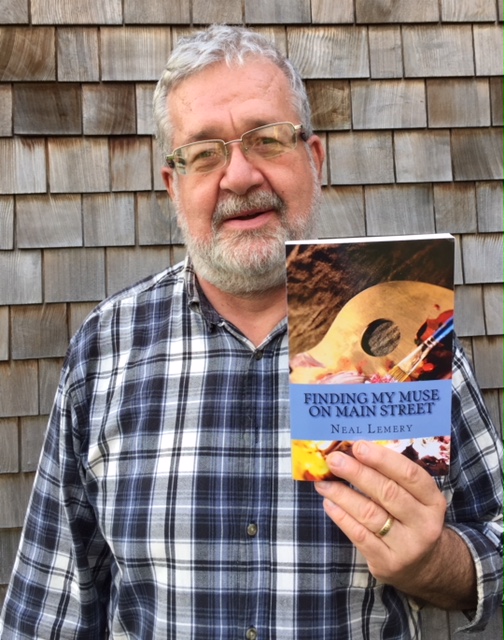
My New Novel, Finding My Muse on Main Street, is Published


Neal Lemery’s new coming of age novel, Finding My Muse on Main Street, has been published and is available on Amazon. The book explores the young creative spirit and the role of art in building community.

Growing up on the Pacific Northwest coast, small town boy Jake Morgan wants to find himself and his purpose in life. With the help of his many friends along Main Street, he lights his artistic creativity on fire. Taking the lead, he forges a coalition of artists, movers and shakers to build a community and open an art gallery on Main Street. Along the way, lives are transformed, including his own, on his way to manhood.


In this young adult novel, Jake discovers his own artistic gifts and dreams, and connects with others along Main Street, who are seeking their own artistic dreams and creativity. Together, they build a renewed community, healing old wounds and reinvigorating their lives.


A recent review praised Finding My Muse on Main Street:


“In this positive, uplifting, coming of age novel, a creative young man struggles to find his artistic self, with the help of the inhabitants of a small, coastal town. As he walks the path before him, he learns that almost all the people he knows have private, artistic lives which give them strength to endure the vagaries of life. The more he learns about and from them, the more each artist encourages him in his journey, the more he grows to know the path to himself involves making a place for the artists he knows where they can share with each other the art they create.


“The author shows how art can both forge connections and heal a broken soul, making it whole again, turning naysayers into enthusiasts of the creative spirit. I found myself cheering for the young man who cared enough for others to make his town a lovely place at the same time he was creating his own life.”


Lemery will hold a reading from his book during the downtown Tillamook, Oregon monthly Art Walk, on Saturday, February 24, 2018, at the Art Accelerated gallery, 1906 Third Street, Tillamook, from 1 to 3 p.m.


Lemery, a retired judge and now a community volunteer, is the author of Mentoring Boys to Men: Climbing Their Own Mountains and Homegrown Tomatoes: Essays and Musings From My Garden.


            More information is available at http://neallemery.com

Seeking An Intelligent Inquiry and Conversation


How does one navigate community political discourse in this age of apparent propaganda, half truths, and dogmatic black and white thinking?

A government clerk engaged me this week on my thoughts about Michael Wolff’s runaway best seller on Washington dystopia. When I opined that the book presented a significant amount of information that was critical, that there appeared to be substantial dysfunction and lack of moral compasses in the current administration, centered at the top, he seemed to agree, then caught himself.

He then abruptly sidestepped the conversation, to praise the recent federal tax code changes, expressing delight that Apple would now bring back billions of dollars into the American economy.

While that statement would warrant some serious fact checking and deep analysis of public tax policy, international macroeconomics and trade policies, my conversational partner quickly nodded off my obvious skepticism of his statement, and turned to his next customer.

I was left hanging, with an unresolved conversation, and yet another encounter of bold statements unsupported by intelligent discourse and informed debate. Such is our current level of community conversation and social dialogue. Conversation by ambush, and don’t go too deep.

Such encounters run counter to our duty as citizen to be of a curious mind and to demand that a point of view stand on its own, based upon truth and reason, and at least a mostly well informed factual foundation.

We need to be on guard against false logic, propaganda, deceptive thinking and hidden agendas.

Instead, I am a seeker of Truth and leading a purpose-driven, meaningful life aimed at bettering humankind, and being congruent with thoughtful, goal-oriented moral values. That conversational topic can actually challenge all of us to assess our own views, and perhaps grow our minds, even alter our opinions.

In my questions and along the path of my search for truth and moral focus, I aim to strive to focus on thoughtful logic, challenging questions and science-based methodology.

In applying these principles and processes to current events and publicly expressed and popular viewpoints, I notice a general lack of the application of researched facts, moral principles and thoughtful, persuasive reasoning.

Instead, the rhetoric is dogmatic, emotional (primarily fear-based), and beset with half-truths, falsehoods, and unsupported conclusions.

It often appears that the goal of the one who makes the declaration of a certain political view is often not seeking a lively debate, truth or intellectual development. Instead, there is an attempt to persuade by false logic, even outright lies, and changing the argument in mid-course, a mixing of two distinct trains of thought and reasoning, hoping, apparently, that the listener would simply agree with both conclusions and points of view. And, all the while ignoring the concept that perhaps many issues and social questions are inherently complex, and that reasonable people may reach different conclusions and viewpoints.

Life, however, and its complexities, rarely allow that luxury of simultaneously accepting two viewpoints on two vaguely related topics. It is an unsatisfying mix of apples and oranges.

I simply want to engage in informed and interactive conversation. Perhaps in that, we will each grow in our thoughts, and be better informed citizens in our community.

Gratitude and Aspirations: My Intentions for the New Year


By Neal Lemery


“Do not spoil what you have by desiring what you have not; remember that what you now have was once among the things you only hoped for.”
― Epicurus


At the beginning of a new year on the calendar, I am reminded of the many things that I am grateful for in my life. I celebrate all of that, and seek to be mindful of those treasures: friends, experiences, opportunities, and being present in a beautiful place on this Earth.


Gratitude is being thankful. And, being patient for what has come into my life and what awaits me in the future. By living in the moment, I can fully appreciate and be grateful for what life has brought to me and who I am becoming. I am a work in progress. Perhaps I need to wear a “construction zone” sign around my neck to remind me of that.


Being present with my intentions, and focusing my intentions on what is to come is my goal for this coming year.


In this coming year, I intend to:


  • Be fully present when I am with others. I need to listen with an open heart and an open mind, and be tolerant of our differences and the wisdom and experiences of others. In doing that, I will learn and grow. Remind myself that I have one mouth and two ears for a reason, and that I am only learning when I am listening, and not speaking.
  • Work out of my comfort zone. Try something new, something challenging, and strive to have new experiences and opportunities. I will only grow when I am challenged. I only learn when I am uneasy with whom and where I am at. Allow others to be my teachers and guides. Be open to new ideas, new viewpoints.
  • Be a lifelong learner. Embrace new experiences, listen to different and challenging ideas, read books I disagree with, and be open to other ideas. Be tolerant and mindful. Wisdom comes from unanticipated sources. Remind myself that I may be wrong, that I can change my mind, that I am not all knowing.
  • Embrace creativity. See the art in everything in my life, and seek out the creative energies of others. Tend to the artist within me, and celebrate the messages of my Muse, pay attention, and allow the Muse to work through me as I create. Tend that fire, and allow the heat of the moment to fill my heart. Grow that creative energy by sharing it with others. In that, I grow community.
  • Build community in everything that I do, everything I say. Do that in big ways and in small, ordinary ways. Have the intention of building community without fanfare or ego, but instead because I am a child of the Earth and it is my moral and ethical duty to improve and grow community.
  • Be fully mindful of others. Heed the saying that one should walk a mile in the shoes of another. Every person has their own wisdom, their own Truth. Be a good example of what I value.
  • Live life according to my morals, my ethics, my beliefs in the goodness of others, and the unity of humankind. Small kindnesses can open hearts.
  • Speak out against intolerance, fear and hatred. While silence has its place in changing the world, let me be aware that there are also times to speak my peace, share my thoughts, and take action for the good of all.
  • Act according to my beliefs and my purpose in life. A good life is not all talk and no action. Be congruent with my thoughts and beliefs and act accordingly.
  • Social change comes from being a example of what I want to see in the world. Life is not “do as I say and not as I do”.
  • Avoid judgment. I strive to avoid assumptions, or jump to conclusions. I cannot assume the roads traveled by others. I seek to be compassionate.
  • Act with humility. Recognize that I don’t know everything. Life still has lessons to teach me. Be open to new ideas and new experiences.


12/31/2017

The Real Presents Under the Tree


Christmas Eve, 2017


I’m sitting by the fire, with a mug of coffee, watching the cold rain fall outside, almost turning to snow.

The presents are wrapped and under the tree, brightening up the living room. Soon, dinner will be in the oven, and the merriment of Christmas will begin.

The real joy of the season, and the real presents to be enjoyed, won’t be found under the tree. The true gifts of Christmas have already been given, and our hearts are already filled with the joy of the season.

That joy, that “reason for the season” is found in relationships.

It has been a year of reaching out, reconnecting, and opening our hearts to one another. Friends and family have shared their fears, their uncertainties, their doubts. Many have had their lives turned upside down, and have been left fearful of their future, and their own abilities to captain their ships through storm-tossed seas.

This year, I’ve made it a point to reach out and share time with many people. Being a good listener, offering comfort and solace. Realizing that each of us is an instrument of change. One person can make a difference. It’s a simple truth.

Often, simply showing up and being there for someone has warmed our hearts and provided a safe harbor during the storm.

Last week, I visited two young men in prison. Both of them were filled with doubt and uncertainty, feeling lost and unsupported in their journeys. We talked, we laughed, we shared our stories of our struggles and doubts during this year.

We each took comfort in the other’s big hearts and willingness to extend hands of friendship.

Behind cold walls topped with razor wire, I found the light of personal commitment to a better world. Young men, with great courage and great wisdom, speaking from their hearts gave me hope for the future.

We are not alone. None of us are fully confident in our ability to weather the storms of life. Yet, we have each other, and we believe in each other. In our community, by coming together and sharing our hearts and our talents, we will change the world.

This year, I celebrate the gift of friendship, the gift of unconditional love.

What really is important this year is not found in politics, and is rarely talked about on the pages of newspapers, social media posts, or on TV. Yet, I hear it from friends and family, over coffee, and in new books that come my way.

The real treasure we have, and the true power that we hold in our own hands and in our hearts, is the ability to care about each other, to support each other, and to act with compassion and respect.

The answers to the world’s problems won’t be found in the marble halls of Washington, but they will be found in our hearts and in the strength of hands holding hands, people walking alongside other people, and working towards our common goals and implementing our common values in the work that we do.

This is a time of rebuilding, and restarting the relationships and the social institutions that have served us so well in the past. In our commonality, our common goodness, there is hope and there is our future.

–Neal Lemery

Gunking Out


Today was the day for those disgusting November outdoor chores that I keep putting off. I am glad that it is raining, giving me the excuse to put it off. Yet, the cascading waterfall over the eaves trough that isn’t draining, making a lake out of the flowerbed, and the leaves molding on the deck, keep nagging at me for attention. No one else is claiming this fun chore.

This afternoon, the clouds cleared for an entire hour and the sun showed its face. It was time. I donned the warm coat, but didn’t bother with sunscreen.

I eased into the experience, first hosing off the deck’s collection of half rotted leaves accumulated from the last three storms. Now that the trees are bare, there is no excuse to wait.

The still dripping eaves trough, and the pool of rainwater flooding the flowerbed called my name. Dark clouds were moving in, signaling the return of the November monsoons. Time was running out.

I wrestled with the ladder, wondering if it will teeter a little too far and send me flying.

“Death by downspout” — will that be my obituary headline?

With one hand on the ladder, and one hand dipping into the great ice cold black water and whatever has morphed into existence here, I plunged in.

I gunked out the eaves trough and the top of the downspout, liberating the thick wad of matted conglomeration of leaves, moss clumps, shingle grit, and whatever else lurks in the eaves troughs.

Webster’s doesn’t think “gunked” is a word, and refers me to “muck”, which can be a verb. I like “gunked” better. It sounds more like the near gagging I experience as my hand pulls out a wad of something, be it gunk or muck. And, that special feeling of black ooze dripping down my arm.

My mind envisions the swamp monster in that old Fifties horror movie, “Creature from the Black Lagoon”. Will it grab me and haul me into the depths of the morass?

I thought of wearing gloves, but, really, nothing gets the job done better than bare fingers fully immersed in icy rainwater and gunk. Dealing with sodden gloves would only compound the experience. You try to fling the evil smelling mess out onto the lawn, but of course, some of the liquid runs down your arm, and splashes on your face and clothes.

The downspout, finally liberated, gurgles to life, releasing a torrent of black gunk and water.

To anticipate a tweet, “the swamp has been drained”.

I climb down from my precarious perch, and find the hose to rinse off my fingers and arm, and everywhere else the mess had landed.

One last wrestle with the hose coils and the ladder, and I am done, ready for a warm house, some serious hand washing and something hot to drink, as the first splatter of the new rain cloud strikes my face.


–Neal Lemery 11/28/17

Just Listen


I almost didn’t pick up the phone. We’ve had a lot of robo-calls lately, and I’ve gotten into the habit of just letting the phone ring. If it is important, or someone I know, they’ll leave a message and I’ll call them back.

The number was familiar. It was the number that called several times in the last few days, the voice familiar, from the past when I volunteered as a mentor in a nearby youth prison. Two days ago, the voice left a distraught, heartfelt message, wanting to connect with me, and alluding that he was thinking of ending his life.

No name, no return phone number. But, my phone remembered the number and I called back, getting the receptionist at another youth prison.

I explained that the voice sounded desperate, sad, alluding to self harm.

“We have 250 youth here, and I can’t track down who may have called you,” the receptionist said. “But, I’ll transfer you to the treatment manager in our mental health cottage.”

But, without a name, I was stuck, hoping he’d call back.

This time, we connected. The voice at the other end was a staff person, telling me that “Joe” wanted to talk to me. He put me on hold, and it was a long wait.

I was hesitant to take the call. Maybe “Joe” was having second thoughts, too, now that I was on the line.

My brain was trying to remember who “Joe” was. The mists of time parted and I began to remember “Joe”. I saw him every week for about a year, until he moved on, getting released to a half way house.

The staff had asked me to see him, as he was falling behind in his school work, and didn’t seem to care. He’d act indifferent and pushed me away, not letting me get close to him. But, I stuck with it, trying to tutor him in the math class that he was failing.

It wasn’t the work, and it wasn’t the level of math. I soon realized he was brilliant, and had taken the road of not doing the work, and blowing the homework and the tests, because it was too simple, too easy. And, if he passed his math class, then he’d graduate from high school. The next step was college.

But, he was a failure, a no good, not worthy of success. I soon learned that his family had abandoned him, never visiting him in prison, or even writing a letter or talking with him on the phone.

“Worthless,” “scum”, those were the words he’d last heard from his family, the day he was arrested, probably a whole childhood of that kind of talk.

I walked around the math conundrum, trying to engage with him on a different level. I learned he loved music, playing and composing songs and rhythms. He’d taken over the keyboard in the rec room and the computer that was set up to record and put together different tracks of music the kids had recorded.

I kept asking me to show me what he’d done with the recording devices, but he kept putting me off.

“It’s not very good,” or “I’m not quite ready for you to hear what I’ve done.”

One day, he let me into that world, playing a very complex rhythm track, and a long electronic music piece that was beyond words in its complexity and beauty.

“It’s nothing,” he said, when I raved about his talent and ingenuity.

“Oh, and you tell me you’re not very good at math, when you can compose this elaborate rhythm and multi-track composition?” I said.

“Well,” he said. And just shrugged.

“It’s not a big deal.”

I wanted to get up on the table and dance!

As I was leaving, I told a staff member how talented Joe was, and so gifted in music.

“I know. He’s amazing,” the staff member said. “But he thinks it’s no big deal.”

At our next visit, he actually smiled.

“I passed my math class,” he said. “I actually got an A.”


Yeah, that “Joe”. How could I forget him?

What’s he doing back in prison, after all this time, I wondered.

The phone line clicked, and a soft, deep voice said hello.

“Is this Neal?” the voice asked. The hesitancy in his voice tugged at my heart.

He said he was amazed I remembered him, that I was willing to talk with him, that I was even listening to him, that he was worthy of my time.

“Joe” had taught me an important lesson. Sometimes, good things happen when you just wait, just enjoy the silence in a conversation, and let that quiet connectedness be the conversation. Just showing up, caring, and listening, can affect fundamental change in someone’s life.

Now, years later, I listened again. His story came tumbling out. There were successes, achievements. And there were disappointments, fears, times of perceived failures and disasters. There came a time when it was all too much, too much goodness going on, and so he pulled the plug, sabotaging himself, and choosing to run away.

The old family voices of being worthless and a scum echoed around his mind. There were prophecies to fulfill, and expectations to satisfy.

There was loneliness, too. He’d had no visitors, no one to call, no one to care.

“Except you,” he said. “Thanks for talking to me.”

I didn’t say much at first, just listened a lot to this sad story, feeling him open up on the phone and share his feelings.

I responded, offering words of encouragement, hope, and concern.

I told him he was smart, creative, a nice guy. I told him I cared about him, that he was like a son to me, that he was important to me, a good part of my life.

He got quiet, and I could detect a sniffle or two, and a few sobs.

I’d come to see him, if that’s what he wanted. Oh, he did. He’d talk to his counselor and see if we could set that up.

“I don’t know if they let people here have visitors,” he said. “It’s the mental ward, you see, and I don’t know if they’d let you come.”

I told him I thought they would, if it would help him out, help him move through this rough patch in his life, help him transition to a better place, and get on with his life.

We exchanged addresses, and I gave him my cell phone number.

I promised to write to him the next day, and he said he’d write to me. We’d get together, and work on a plan for him to move on. We’d stay in touch.”

“Three years was too long, you know,” he said.

I laughed. “Yeah, I know.”

He laughed too, then, and I heard him smile finally.

I remembered his smile, the one he gave me when he played his music for me, that one special afternoon years ago, just before he aced his math class.

“Well, I’ve got to go,” he said quietly. “My phone time is up.”

“OK,” I said. It was great to talk to you. I hope you feel better. I hope you want to live.”

“Yeah, I do,” he said. “I really do. Thanks for talking to me.”

“Call again soon.”

“I will.”

I looked at the clock. Twenty minutes had passed since I’d decided to answer the call. Twenty minutes of sad stories, and sniffling, and some words of encouragement. Twenty minutes of showing up in each other’s life again, and both of us finding the good in that, each filling our hearts with that connection once again.

We all have twenty minutes a day to give to someone, to listen, to hear their story, to make a connection. We all can care about someone for twenty minutes.

That might make a big difference. It might save a life.


–Neal Lemery 10/17/2017

The Power of Silence


I can be pretty verbal. Thirty plus years as a lawyer gives me a well practiced arsenal of words and Socratic debate skills that let me hold my own in the political discussions that surge around my family, friends, and community. I seem to thrive when faced with a point of view that begs for a counter argument, a voice in opposition.

Often, I speak without first asking myself if I should even speak, should I take up the cause. Not every conversation is a call to a debate, or a heated argument worthy of a case before the Supreme Court.

I learn more when I listen, and the proverb that observes we have two ears, but only one mouth, is always worthy of a revisit.

Am I speaking to change someone’s opinion, or am I just arguing for the sake of being a dissenter, knowing that, of course, I am right?

So I often try to practice the art of falling silent, of not engaging in debate. My silence isn’t saying that I agree, either. Let the other person’s words echo and be contemplated in unexpected quiet. Let the speaker’s words and their ideas linger, so that we may truly hear them, and take in what they are saying. Maybe the speaker, in that silence, will hear what they have said, and take the time to really hear themselves.

My silence certainly can’t be taken as agreement, or even acquiescence, in the hypothesis presented by the speaker.

I yield the floor to them, letting them give voice to their thoughts, letting the ideas flow around the room. Perhaps they have never been heard before; perhaps their ideas haven’t been aired.

My ego likes to believe that when the speaker finally stops to hear their own flawed ideas, they will abandon their line of thinking, and agree that I’ve been right all along.

If they are “loaded for bear” and ready for a heated argument, I don’t have to agree to wage battle.   That’s my choice. And, I often don’t learn much if I don my armor and throw my own spears in a heated argument.

There’s the old saying about not learning when your mouth is open.

Thus, I often try to fall silent. My lips don’t move, and I focus on disengaging the clutch between the argumentative brain and my mouth. I keep in eye contact, letting them know I’ve been listening, and I’m still present.

I’m just not engaging in debate. I’m not ramping up the temperature. I’m reacting, just not in the way we’ve been socialized to react.

I’m changing the rules. And, I’m certainly making a point, just not the point that the speaker is expecting.

The interchange gets even sweeter when the speaker asks if I have anything to say, and I don’t say anything. I’m making a point. I’m not invisible, and my silence is not agreement. I’m exercising my power in the conversation, and making a point.

The uncomfortable silence is my friend, a valuable energy in the conversation. I’m expressing myself, by not saying anything. It’s a paradox, one that is often a valuable teaching tool.

What I’m saying, in my silence, is that I hear the other person. But, I don’t have to respond, in the usual way. And, I give them something to think about. Even just letting their words echo back to them, giving them space to actually hear what they’ve been saying, can be a powerful reaction to their words. I’m giving them personal space.

I can think they are being an idiot. I just don’t have to say the words, and go into battle. Instead, I can let them wonder what I am thinking, if they even care about that.

I also don’t have to be the hypocrite, saying I agree even if I don’t, say something benign, or be a diplomat.

From my point of view, it’s a pleasant mystery.

I’m giving them the luxury of contemplation of their own spoken words. How often do we engage in thinking about what we have just said?

They aren’t hearing my approval, and they aren’t getting a verbal response. I’m not adding fuel to their argumentative fires. Instead, I’m letting their flames die down, dropping the temperature, letting things cool.

In that silence, I can grow my disagreement, my dissent. I can also grow the speaker’s own reflection of their own words, and let those words lie exposed to the clarifying sunlight of truth, logic, and social sensibilities.

And, the speaker is now really listening to me. I’m not mouthing words, but I am present, and I am hearing them. My silence is speaking volumes of words. And, what that means is now the puzzle the speaker is trying to solve. The silence is making my argument for me.

I’m not even marshaling my debate tactics and my own thoughts on the subject at hand, except in me being silent. Silent, yet engaged with them, respectfully listening to them, and being present.


“I answer her with my silence, understanding the full power of it for the first time. Words are weapons. Weapons are powerful. So are unsaid words. So are unused weapons.”
― Emily MurdochIf You Find Me


–Neal Lemery, 9/29/2017