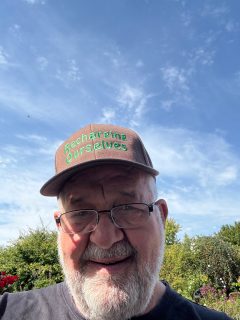
My interview by Tommy Boye at TillamookCow.com, Tillamook’s internet radio, on October 18, 2013
Category Archives for Uncategorized
“The world is changed by your example and not by your opinion.”
—Paolo Coelho
Putting Away Summer
The pile of cushions grows outside of the shop, summer dust and fall leaves swept off, and the heavy dew of this fall morning now drying in the afternoon sun. The chairs, too, and the lounge under the tree, where I spent some afternoons this summer reading, and looking up through the leaves at all the blue, losing myself in a daydream.
The little charcoal barbecue goes inside, too, after I clean out the ashes left over from that last steak and zucchini cooked on the grill, the smoke wafting around, in a fall evening stolen from the summer gods.
The umbrella and chairs around the table on the deck go, too. Its best time this summer was an impromptu dinner with young people, tired and sunburned after an afternoon at the beach.
“Can I invite some friends over?” our son asked. And, the evening was filled with laughter, new stories, and a second helping of corn on the cob, and big slabs of peach pie, vanilla ice cream melting in the evening warmth. The peaches had come from a roadside stand, along with the corn, yesterday’s trip to the valley, where the wheat threshers kicked up clouds of straw and dust into the August sky.
I put away the little red cafe table and chairs in the flower garden outside the bedroom, where we sipped coffee one perfect morning, and then, a bit of wine before dinner, the evening we watched the full moon rise above the mountains, the silence reminding me of my insignificance in the universe ruled by astronomical math formulae, and the laws of physics.
In the garden, I reap the first real harvest of the tomatoes I planted back in May, when nights were cold, and I was gambling on the date of the last frost. The pole beans, too, their pods now shriveled, the seeds destined for a pot of soup on a cold January night, my farmer’s tan long since faded away.
Tonight, we will eat the next to last feed of corn on the cob out of the garden, with fresh sliced tomatoes, and talk about the coming storm.
The cat surprises me by the onions, coming up for a chat, and a long pet. Usually, he’s stalking mice in the corn, or napping under the fennel, too busy to pay me any attention. Here, he is the mighty hunter, the lion on the Serengeti. But, today, he crouches at my feet, needing his ears scratched, needing a long pet. He feels the rain coming, too, not willing to say goodbye to summer.
Tomorrow, a big storm comes, promising close to a foot of rain, and three days of wet. I still need to find my serious raincoat, the one with the hood, long enough to reach to my knees. And, maybe my Alaska pants, the rainproof ones that slide over my jeans, for those treks into town, or maybe the beach, when the wind pushes the sheets of rain sideways, and maybe even up a bit, until that bit of uncovered cloth gets soaked, sodden against bare skin.
But, today, the sun is out, warm against my skin, still ripening the tomatoes I’ve found to put in my bucket, still warm for the yellow jackets feasting on an old apple I dropped in the grass a few weeks ago, when I’d found enough apples to make a pie.
The chairs in the garden come in, too, no longer needed for me to rest, and let the sweat dry, after digging or hoeing or planting in the garden, my fingers black with ground in dirt, my eye admiring the row of seedlings, or the patch of now weed free salad coming on.
And the wind chimes, their pipes making one last horrendous clatter, as they argue against me putting them in the garage for the winter. A vine has snaked its way around the hook, so I tug hard, ending another summer friendship.
“One last song,” they beg. “We will make it pretty, just catching the breeze, as you play your guitar in the evening, on the deck, the late evening light lighting up the pink on the roses.”
No, it is time to go now. That storm is moving in fast, and soon everything will be wet, the evenings even now so much earlier. We are past the Equinox now, moving fast towards Halloween and the first frost. Summer has lingered, but now its gone.
One last slow sunset now, the sky still empty of clouds, the horizon’s blue turning darker by the minute, until I finally realize that it is night. I can smell the coming rain, a bit of wet, a bit of damp leaf, with a hint of toadstool.
In the shop now, the stacks of chairs and cushions, and fun little garden ornaments, and the old dresser mirror we painted red and hung on a tree, sit there in silence, put away.
The metal windmill sulks in the corner by the wood stove, its blades still now, no longer catching the wind in the garden, telling me if we might get a summer shower, or that tomorrow, the breeze off the bay will make the corn stalks whisper, as they aim for the sky.
I shut the door and head in now, my shoulders aching from the day’s work. It is time, now, for all of us to rest a bit, even the metal heron that guarded the roses, even the chair by the redwood tree, where I read my books, and played my new summer song on my guitar, not so long ago.
Neal Lemery, 9/27/13
Possibility in the Air
It was Book Day. I found myself in a college book store, with a young man I’ve been helping a bit, getting him started in college, helping him move along a bit in his life, starting something he’s been dreaming about, something that’s scary, too.
The unknown ahead is always a bit scary. Something new, untried, unfamiliar. Even if stepping ahead, out of one’s comfort zone, is a good thing, part of me wants to hold back, be cautious and safe. There is a bit of doubt, “I am not good enough for that.”
Book Day breaks me out of that old cycle, that rut of thinking that I can’t move forward. It is a day overcome with newness, of learning, of growing, getting out of my rut.
I wandered around the aisles, looking at shelves bulging with textbooks on every subject in the college catalog. I have to be careful, or I’d be buying a few for myself. I always find something in a bookstore that I’d like to read, especially if I don’t get graded on what I read. But, I could slip in after the bell, find a seat in the back row, and get myself lost in the lecture, taking notes, feeling the juices in my brain flowing with excitement, all the new ideas.
The student was having fun, too, finding his books, filling up his basket with what he was going to be studying this term, enjoying that thrill of a new adventure, new challenges. I caught him humming a happy tune, as he was perusing a book. The sparkle in his eyes told me his story today. He was moving ahead, living his dream.
The best part of book day is that sense of adventure, and discovery. All the newness of the day: classes, professors, students, books, and, especially, new ideas. So many doors to be opened, so much opportunity.
Today, there are no limits, no restrictions on what may lie ahead.
Possibility fills the air, and I breathe it in deeply.
Neal Lemery 9/8/2013
To Forget
The list of things to forget
brought me to remember what I’d lost
and not wanted to find ever again–
to pains and ashes and broken hearts
of long ago and yesterday,
all coming back.
To write it down becomes remembrance–
I try mourning again, like the obituary
falling out of the well fingered Bible,
old and tattered, its fluttering downward
bringing fresh tears.
In trying to forget, I remember again
the joys and smiles and songs well sung.
Those notes dull the pain of what
I came here to forget, but
need to remember
again.
—Neal Lemery, 9/2/2013
Sally Jo Survives Sixth Grade out in paperback

Sally Jo Survives Sixth Grade: A Journal
by Karen Keltz
Link: http://amzn.com/0985728116
by Karen Keltz
Link: http://amzn.com/0985728116
This great book for middleschoolers of all ages is now available in paperback at Amazon.
Kana Hanai
In the Hawaiian language, kana hanai is loosely translated as “my adopted child or children, my foster child”. In Hawaiian culture, the word “hanai” (Hah NIE) has a deeper, more complex meaning.
It is the taking in of a youth, who needs some parenting, some nurturance and love that is different than the love and nurturance of biological parents. The hanai child becomes part of the family, not only physically, but emotionally. That child is treated as one of the family’s children, loved and nurtured, and cared for as one of their own. You become an “extra” parent, the additional aunt or uncle. There’s a lot of aloha, of unconditional, unlimited love and concern.
When I was growing up, hanai children could be found occasionally at our dinner table, or spending a month in the summer. My mother spoke lovingly of her aunt, and her ninth year of life, living with her aunt, and seeing the world in a different way, soaking up her aunt and uncle’s love and concern. That year got my mom through some tough times, and gave her new strength, and a new lease on childhood.
In our house, there was always an extra chair, and room at the table for another face, and, if we had dessert, we all shared. None of us kids dared to complain. Having another kid at the table was nothing new, and mom would always be a little happier than usual as she was cooking dinner. Conversation around the table was always lively, and included them, making them feel welcome, a part of family.
My wife and I carried on that tradition after we got married, and took it farther. We lived in town and my stepson’s friends were usually in the yard, or playing music in the house. When it was dinner time, we set the table with another plate or two, and shared our food, and conversation. There was always laughter, and some good stories.
And, sometimes, when we would plan a family outing, a picnic or a hike, that other kid who seemed to be in the house a lot usually came along.
A few years after my stepson went off to college, my wife came home from school one day with a sad story, telling me about one of her students who needed a place to live.
Another son, she said, a hanai child, needing to be coming home.
The spare bedroom became his room, and I found an old dresser for $10, and sanded it down, and put on a couple of coats of paint. Our dinner table was now set for three, and we had teenage music and laughter and mood swings in our house again. We had a front row seat in watching this newest man child grow up and find his passions.
And, soon, his friends would come by, and manage to stay for dinner, and breakfast in the morning. When they were busy having fun downstairs, and watching a movie or playing games, or listening to music, I’d knock on the door with a plate of cookies fresh out of the oven, and a jug of milk.
There were looks of amazement, and big grins as the plate of cookies and the milk quickly disappeared.
We’d take some of those kids to the beach, along with our dog, and pack extra food in the picnic basket.
One summer, one of the boys had pretty much moved in, and I was wondering if I needed to remodel the storage room into a place for him to sleep. One afternoon, his mother called. The guy had been sleeping on our couch, and the end of the kitchen table was his regular place at dinner.
“Is Joe there?” she asked.
Indeed, he is. And it took you over a week to realize you hadn’t heard from him?
Oh, mom, you’ve missed a week of his laughter, of his giggling when he plays fetch with the dog down on the beach, a week of his jokes at the dinner table.
No wonder he’s about moved in here. We’ve been keeping track of him, making sure he has a few meals every day, and a place to sleep. His laundry gets washed and he’s taken on a chore or two to do around here. It’s all part of being in the spirit of hanai.
One time, we took one of the boys to the big city with us, on our annual August back to school shopping trip. I’d had to make a quick trip down the road about forty miles one night, to help him get his back to school money from his dad, before his dad headed off to the tavern with that cash in his wallet.
There was real fear in the eyes of this hanai child, fear that the money would be drunk up before we got there that night. On the way back home, he fell asleep in the back seat of the car, worn out from a day of worrying.
When we hit the big stores in the city, my newest hanai child grinned as he was buying his school supplies, and cried a bit, when I had him pick out a new school back pack, and put it in my cart.
“For you,” I said. “You need a new one for school, you know.”
He looked away, leaning on the shoulder of our foster son, tears welling up in his eyes.
Kids grow up and they move away. And, I never feel really bad when I wave at them as they head off. It is time for them to go, their wings are strong and they are ready to fly. We’ve done a good job, being good parents to each one of the kana hanai who have come into our lives.
We still have our kana hanai. Most of the newer guys live not too far away, living behind prison bars. They stumbled and fell when they were kids, and are working on reinventing themselves, learning to become adults. There are a lot of reasons for that, but they’re still just kids, young men wanting to test their wings, wanting to be part of normal. We go see them often, and celebrate their birthdays, and listen to their stories, and ask how they are doing in school, how they are making their way through their lives.
We pay attention to them, we care about them, and we listen to them. We show up, and we come to visit when we say we are coming. And, a lot of that is foreign to them, and they don’t know quite what to make of it. Just like a lot of the other hanai kids I’ve had in my life, kids just wanting to be normal.
When they get out of prison, they come to our house and eat dinner with us, and play games and go to the beach. Just like all the other hanai children in our lives, we put their pictures on the fireplace mantel, and talk about them with our friends.
We go visit them and spoil them a bit, as they share their challenges and their successes with us.
A few years ago, we spent some time in Hawaii, talking with families and some parents of kana hanai. We shared our stories, and our love for our adopted ones, lost kids we opened the door to, and invited in for some family time, providing a refuge from the world, and a place to laugh and be themselves.
In Hawaii, those who have hanai children have a special place in the community. They have a special place in the village, a place of honor and respect. They are seen as the special glue that keeps their culture healthy and their children strong. Kana hanai families are a big part of the fabric of the community, and a savior of youth who could become lost, and even thrown away.
My village isn’t in Hawaii, but we have a lot of kana hanai, and a lot of parents of their beloved hanai. And, together, we are raising a stronger village, rich in kids, and rich in the spirit of aloha and kana hanai.
I wouldn’t have it any other way.
8/27/2013
Guess what starts next week?
A great book for everyone in the family, and everyone who knows a middle schooler
We Still Need To Dream
I’ve been wondering how I could commemorate Martin Luther King’s “I Have A Dream” speech, on the fiftieth anniversary this week of that watershed event in American society. I was ten years old, in 1963, and his words were part of that fire starting in my soul, the start of a passion for justice and possibility for every person. That fire burns in me still.
And, within an hour yesterday, I was immersed in an intensive, hands on, exploration of racism and prejudice in my community, and the experiences tested that fire inside of me, and got it to blazing into a righteous bonfire.
I’d gone into town for a haircut and a cup of coffee, maybe working out at the gym. My regular barber wasn’t working, so I slipped into the chair of another hair stylist at the salon, telling her the few things I wanted in the haircut.
Another customer came in, interrupting us, insistent on getting her hair styled. I felt my stylist tense up, her jaw tight.
“I’m not able to take you today,” my stylist said, a slight edge in her voice. “Someone else will be here in fifteen minutes. You can come back then.”
The customer left, and my stylist flew into an animated discussion with me and the other stylist in the shop, about how that customer had ranted and raved about the “wetbacks” and “lazy Mexicans” the last time she was here for an appointment.
“Look, I’m Mexican,” the stylist said, her arms flailing, her scissors nearly flying out of her hand. “My family works hard. My husband is working two jobs, jobs most Americans won’t do. We’re not on welfare, we don’t have food stamps. We work hard for everything we have here.
“How dare she say we should go back to where we came from. Her ancestors were immigrants, too. If we go ‘back’, then, she should, too,” she said, her rapid snips with her scissors shaping up my shaggy mane.
“I’m not going to cut her hair. I’m not putting up with people who are racists, people who judge people by the color of their skin, or where they came from. I just don’t understand people like that.”
She cooled off a bit, then, and we had a rich conversation about prejudice, and bigotry, and people who lump a big group into some category, and have opinions that ignore the facts, ignoring how people work hard, and struggle, so that their kids can have good, productive lives.
I left the salon with one of the quickest haircuts I’ve ever had, newly energized by her anger, and again saddened by the rudeness and bigotry that was still alive and thriving in my hometown. My stylist wasn’t afraid about speaking her mind. And, if she can speak up, maybe I can, too. Her power and her courage were at my back as I headed for my car.
Ten feet out the door, a young friend came up and spoke to me, inviting me to go have a cup of coffee. We’d spent a day not long ago looking at universities, exploring options for him to study for his bachelor’s degree. We’d both learned a lot that day, and it would be fun to debrief a little, and find out what he’d been thinking about, what he was planning for his future.
As I unlocked the car, my phone rang. One of the guys I’ve been mentoring, a young man I now consider to be a son, was calling.
“I need some advice,” he said. “People at work want to know about my past, but if I tell them everything, then I think they will judge me, they will just think I’m just a criminal, they won’t really look beyond that, and see me for who I really am.”
We had a rich conversation, about prejudice, and bigotry, and how we all need to not let bigots get close to us, and put us down, judging us without really knowing us. About how we don’t need to let others manipulate us, and put us in pigeon holes, so that we don’t have to play the role of being less than someone else. Each of us has value, we are children of God, we are beautiful people. We are more than our skin color, or where our ancestors came from, we are more than one thing we might have done in the past.
We talked about self care, and standing up for yourself, about living life with pride and direction, purpose. We talked about appreciating people by their character, by their ethics and morals, and not by some preconceived, uninformed stereotype.
I told him the story of my hair stylist, how she had drawn the line in the sand, refusing to work with a client who would stereotype her, and put her down, to degrade and prejudge her life and her family.
He took that all in, and figured out a strategy on coping with people who would prejudge him and gossip about him, people who would easily put him into a category of “others”, people who wouldn’t appreciate him for the beautiful, creative, and loving person that he is inside.
I drove down the road to the coffee shop, running a bit late after my deep conversation with my son. My buddy was already sipping his coffee, his nose deep in a thick textbook, one that absorbed his curious mind about the science of his new job.
We talked about what he’d been learning about all the colleges and programs he could apply for, and all the careers he could explore.
And, we also talked about the conversation I had with the hair stylist, and her bigoted customer.
“I’m a wetback, too,” he said, with a bit of pride. “I came here when I was eight, because my mom wanted me to get an education, and make something out of my life.”
He talked about his struggles to make it through high school, and then community college. He talked about not being able to get a driver’s license, about working under the table at a farm, so he could help his family and find a few bucks for school clothes and books, and gas.
He talked about the farmer he used to work for, and how the farmer would rant and rave about all the wetbacks and illegal immigration, and how the government was wasting a lot of welfare money on the “dirty Mexicans”. And, then the farmer would pay him under the table, and not take anything out of his pay for taxes and social security, and how the farmer didn’t see the disconnect in his thinking, and about how the farmer was breaking the law, and taking advantage of those “dirty Mexicans”, the “dirty Mexicans” he happily underpaid to milk his cows and shovel manure and do all the other hard work that he couldn’t find anyone else around this town to do.
He talked about how tough it was to go through all the hoops and finally get an immigration card that lets him be here legally, as long as he’s going to school, and how it is still another ten years before he might become a citizen. And, how his parents still drive to work without a valid license, and how they can never become citizens, even though they’ve lived here for the last twelve years, they have jobs, and they make sure their kids get to school, how they are good people, people this country should be proud to have as citizens.
People just like my ancestors, my people who came over on the boat, who took the awful, low paying jobs, so that their kids could go to school, and their grandkids could be doctors, lawyers, and engineers.
He talked about getting stopped by a cop late one night, just him and the cop on a lonely, dark country road; and how the cop yelled at him for breaking the law, for finding a way to get a driver’s license from another state, so my buddy could still get back and forth to work, and college, and take care of his family. He talked about how the cop called him a “wetback” and how “you people” should go back where you came from.
I know this cop. I’ve been a lawyer and a judge and I’ve had the cop in court many times. I’ve never heard that viewpoint from him, and it’s probably good for him that I didn’t. I have a dream, too, thanks in part to Martin Luther King’s work and beliefs that society can change, that we can accept others for who they are, and not to judge people by the color of their skin, but instead by the strength of their character.
If we really believe in the rule of law, if we really believe that each one of us is a child of God, that we are here to live lives of service, and compassion, and understanding, that every person is precious, and has endless possibilities to live a life of beauty and love and value.
That cop would hear that speech from me, again, and I think I’d be pretty impassioned about it, drawing on the passion my hair stylist had about dealing with racists and bigots.
I was pretty worked up by the time I got home, inspired to read Dr. King’s speech again, to dig a bit deep inside of me, to explore my prejudices and my biases. What I was wanting to say was on the stove, still warm, simmering, waiting for the muse to strike, to get my words down on the computer.
Then, last night, I’m taking a troll through Facebook. I see a young friend has posted a video. “Funny” he writes, so I take a look.
The video shows a white guy advertising a laundromat that only washes white clothes. It’s the “white’s only” laundry. The next scene is him again, saying that the first ad has riled up some people, so he’s changed the name to “no coloreds”, and offers Black people a side entrance to the laundry.
As my blood begins to boil, I struggle to keep watching, dreading what the next scene might be.
The white man comes on again, saying that the “no colored’s” name bothered some people, so he was going to change the name again to “Uncle Tom’s Laundry”, but that there would still be “no coloreds” washed and dried there.
I sat there, stunned, not really knowing how to react.
After all, it has been more than fifty years that Rosa Parks sat in the front of the bus, it has been fifty years since the March on Selma, and Dr. King’s speech at the Lincoln Memorial.
It’s been a shorter period of time since my home town repealed the “sundown law” that said Blacks had to leave town at the end of the day. It’s been a shorter period of time since some of the social clubs in town have allowed Blacks and women to sit in their bars and have a drink, and become members, even officers.
And, it’s been less than a day since a young friend posts a video about “no coloreds” for all the community to see, and maybe even guffaw about.
We have a black president, we have a black attorney general, we have black judges and members of Congress.
Yet, 2013 also has the Trayvon Martin shooting trial, and an agonizing, disjointed national discussion about what that was and what that means. We have the US Attorney General, on national TV, talking about how he feels he needs to tell his son, a black teenager, about the dangers and risks of being young and black on the streets of our national capital late at night, about how to be leery of cops, about being judged because of the color of his skin.
And, 2013, in my town, we have these conversations, and these racist, bigoted comments and attitudes, and videos posted in social media that are thought of as “funny”, but are as racist and bigoted as the cross burnings and Klan marches, and segregated busses and lunch counters and schools of the 1960s.
We aren’t there, yet, not by a long shot. But, I can still dream. And, I can still be angry, and intolerant of racism and prejudice, and putting people down because of where they came from, or the color of their skin, or the language they might speak.
We have a ways to go. We still need to dream.
Neal Lemery, 8/24/2013
Punishment or Rehabilitation
Punishment or rehabilitation?
We have a choice. We can change lives.
Punishment Fails. Rehabilitation Works.

James Gilligan, a clinical professor of psychiatry and an adjunct professor of law at New York University, is the author of, among other books, “Preventing Violence” and “Why Some Politicians Are More Dangerous Than Others.”
UPDATED DECEMBER 19, 2012, 11:43 AM (originally published in the New York Times)
“If any other institutions in America were as unsuccessful in achieving their ostensible purpose as our prisons are, we would shut them down tomorrow. Two-thirds of prisoners reoffend within three years of leaving prison, often with a more serious and violent offense. More than 90 percent of prisoners return to the community within a few years (otherwise our prisons would be even more overcrowded than they already are). That is why it is vitally important how we treat them while they are incarcerated.
“How could we change our prison system to make it both more effective and less expensive?
“The only rational purpose for a prison is to restrain those who are violent, while we help them to change their behavior and return to the community.
“We would need to begin by recognizing the difference between punishment and restraint. When people are dangerous to themselves or others, we restrain them – whether they are children or adults. But that is altogether different from gratuitously inflicting pain on them for the sake of revenge or to “teach them a lesson” – for the only lesson learned is to inflict pain on others. People learn by example: Generations of research has shown that the more severely children are punished, the more violent they become, as children and as adults. The same is true of adults, especially those in prison. So the only rational purpose for a prison is to restrain those who are violent from inflicting harm on themselves or others, while we help them to change their behavior from that pattern to one that is nonviolent and even constructive, so that they can return to the community.
“It would be beneficial to every man, woman and child in America, and harmful to no one, if we were to demolish every prison in this country and replace them with locked, safe and secure home-like residential communities – what we might call an anti-prison. Such a community would be devoted to providing every form of therapy its residents needed (substance abuse treatment, psychotherapy, medical and dental care) and every form of education for which the residents were motivated and capable (from elementary school to college and graduate school). Getting a college degree while in prison is the only program that has ever been shown to be 100 percent effective for years or decades at a time in preventing recidivism. Prisoners should be treated with exactly the same degree of respect and kindness as we would hope they would show to others after they return to the community. As I said, people learn by example.
“My colleague Bandy Lee and I have shown that an intensive re-educational program with violent male offenders in the San Francisco jails reduced the level of violence in the jail to zero for a year at a time. Even more important, participation in this program for as little as four months reduced the frequency of violent reoffending after leaving the jail by 83 percent, compared with a matched control group in a conventional jail. In addition to enhancing public safety, this program saved the taxpayers $4 for every $1 spent on it, since the lower reincarceration rate saved roughly $30,000 a year per person. The only mystery is: Why is this program not being adopted by every jail and prison in the country? Why are taxpayers not demanding that this be done?”
Why indeed?
 Neal Lemery